Forecasting that fits a long-tail catalogue
Wines, books, niche hard goods, hobby retail: slow-rotation specialty doesn't look like FMCG, and most forecasting tools were built for FMCG. Voorcast was designed for catalogues where most products sell now and then, and one global rule is wrong for much of the range.
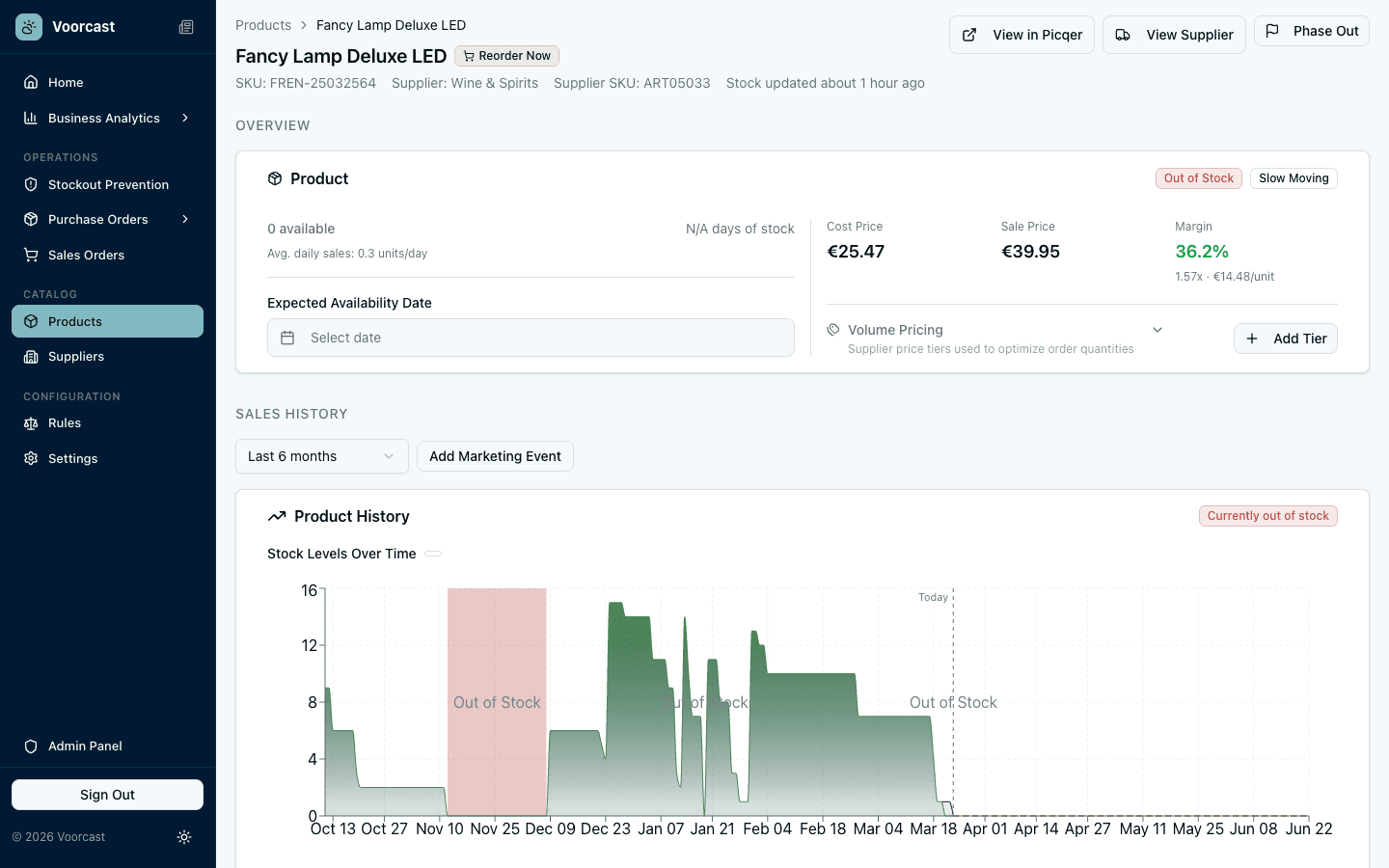
What changes for specialty
Built for catalogues where most SKUs sell intermittently
Long-tail catalogues, handled
Slow movers, intermittent demand, and specialty long tail are the norm. Voorcast scores each SKU against your own demand distribution, not a global default.
Judged against your own range
Dead stock, fast movers, and reorder timings are derived from your own catalogue percentiles, recomputed continuously as your assortment shifts.
Confidence on every forecast
Specialty SKUs often have thin sales history. Voorcast surfaces forecast confidence transparently, so you know which recommendations to trust.
No setup, no maintenance
Connect Picqer or Magento, leave it. There's no best-sellers list to maintain, no thresholds to tune, no spreadsheet to sync at quarter end.
The difference
Stop fighting tools built for fast-moving consumer goods
Most forecasting tools assume your top 200 SKUs do most of the work. In specialty retail, the long tail is the business.
FMCG-built tools ask you to
- Configure a 90-day dead-stock cutoff that’s wrong for half your catalogue
- Maintain a hand-curated best-sellers list
- Set reorder thresholds per SKU and re-tune them every season
- Flag seasonal items manually before each peak
- Re-export to spreadsheets when stock can't be forecast cleanly
- Argue with a tool built for FMCG that doesn’t understand long tail
Voorcast does this for you
- Dead-stock cutoffs derived from your catalogue’s actual age distribution
- Best-sellers recomputed continuously from rolling sales velocity
- Reorder timing derived from forecast, lead time, and supplier reliability
- Seasonality decomposed automatically from your sales history
- Confidence scores surface where the forecast is thin, with no false certainty
- Built for slow-rotation specialty as a primary use case
How it actually works
What's normal depends on the product
A 90-day dead-stock cutoff is right for some catalogues and badly wrong for others. A premium wine merchant with 4,000 SKUs and an average inter-sale gap of months would have most of their stock classified as dead, even though the inventory is performing exactly as expected.
Voorcast doesn't pick a default cutoff. It reads the distribution of inter-sale gaps across your own catalogue, picks the percentiles that correspond to actually-stagnant inventory, and recomputes them as your assortment shifts. The same engine scores every classifier (fast movers, watch list, stockout risk) against your own data.
The practical result: you don't get the “why is this flagged?” problem that breaks trust in forecasting tools, and you don't need to retune anything as your catalogue grows. The system adapts to your truth, continuously.
See it on your vertical.
Voorcast was built for catalogues where most SKUs sell intermittently and one global rule is wrong for much of the range. If that's your shape, the engine fits.
Request Early Access